
Insect-Pathogen Interactions

Bacterial Infection and Anti-Immune Defense
Our team primarily studies infection by opportunistic bacterial pathogens. These are bacteria that are perfectly happy living in the abiotic external environment, but that are also capable of establishing infection if given the opportunity. We work almost exclusively with natural pathogens of D. melanogaster and other insects, and the majority of the strains we work with were originally isolated as infections of field-captured flies. However, these bacterial species tend to be broad generalists, and many of the same species that infect Drosophila also opportunistically infect humans. We are interested in the mechanisms that these pathogens use to establish infection and overcome host defenses, specifically including stress responses, cell envelope modifications, and immune-suppressive defenses that enable evasion or neutralization of host antimicrobial peptides. We hypothesize that the anti-immune strategies used by these generalist opportunistic pathogens to overcome Drosophila immune defenses may be similarly effective against innate immune defenses in humans.

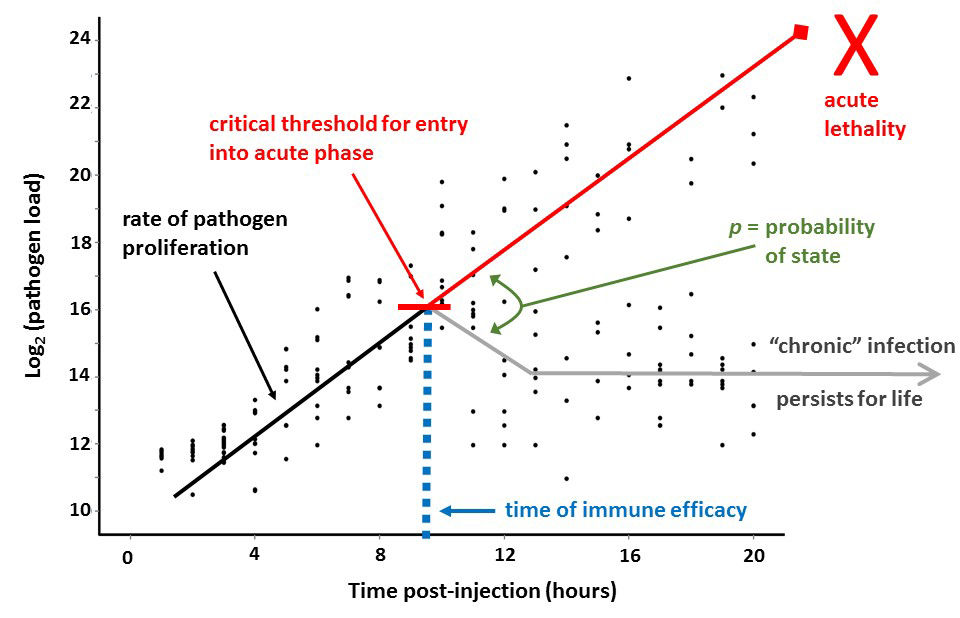
Most of the bacterial infections we study result in bifurcating infection outcomes, where some individuals die with high pathogen burdens while others control their infections and carry an asymptomatic chronic infection for the remainder of life. Each point in the plot above represents the pathogen burden of a single D. melanogaster measured at the indicated time post-infection. The probability that an individual's infection will become lethal depends on the speed of immune system activation and the rate of pathogen proliferation, which in turn depend on the genotype and physiological state of both the host and pathogen. We are working to understand how the chronic infections are established and maintained.
Chronic Bacterial Infection
In the majority of our experimental infections, a subset of the hosts succumb to infection while the remaining proportion survives. The individuals that die from infection typically do so with infection burdens that reach 100 million bacteria per individual fly. One surprising observation, though, is that D. melanogaster which survive our experimental bacterial infections rarely clear their pathogens. Instead, the infections stabilize after approximately two days and become largely asymptomatic, in some cases despite the continued presence of more than 10,000 bacterial cells circulating in the fly. We initially observed this behavior with Providencia rettgeri infections and we have since confirmed it after infection by a broad range of unrelated bacterial species. These chronic infections are remarkably stable over the lifetime of the host and cause no substantial decrease in lifespan or fecundity under laboratory rearing conditions. The host immune system remains upregulated in response to the infection but is ineffective at eliminating it. Our team is currently trying to understand how these chronic infections become established, why the bacteria become impervious to host immunity, and why there is so little associated pathology. We are using genetic and transcriptomic approaches on both the fly and the microbe to try to determine what changes occur in the bacteria during the transition from acute to chronic infection, and whether the switch from a lethal to a chronic trajectory is driven by the bacteria, the host, or an interaction between the two.
Although we were initially surprised at the ubiquity of chronic infections, we subsequently realized that nearly all of the bacteria that we regularly work with were originally isolated as infections of field-captured D. melanogaster. That collection would almost certainly be enriched for bacteria that are capable of establishing persistent infections with minimal adverse effects. Nevertheless, the observation that so many diverse bacteria are capable of establishing qualitatively similar infections raises questions of how they do it, whether they all do it the same way, and whether they do it the same way in different hosts.
Host-Pathogen Feedbacks

Using a combination of empirical experimentation and mathematical modeling, we can describe a system of feedbacks between host and pathogen that is parameterized with realistic values. Mathematically, we can then test how quantitative shifts in host and pathogen parameter values might be expected to influence infection outcome. This allows us to make predictions about which elements of the host-pathogen dynamic are most sensitive to perturbation, or where small changes in the biological function might have the biggest effects on infection outcome. We couple the modeling with complementary genetic manipulation of the pathogen and host, allowing us to test the feedback mechanisms experimentally.
Working in collaboration with mathematicians Steve Ellner and Alex Vladimirsky, microbiologist Tobi Doerr, and Drosophila immunologist Nicolas Buchon, we have begun to mathematically and empirically examine how dynamic feedbacks between host and pathogen can result in bifurcating infection outcomes. This work was initially motivated by our observation that experimentally identical infections result in death with high pathogen burden in some individuals but asymptomatic chronic infections in others. We were able to show mathematically that small differences during the early phase of infection in either the rate of pathogen proliferation or the lag time in induction of the host immune response are sufficient to send the infection onto highly divergent trajectories. We subsequently showed that the outcome of infection can be strongly impacted by continued absorption of AMPs or other immune defense molecules by the corpses of bacteria that have already been killed by the host immune system. This “sponging” of host immune molecules has a paradoxical dual outcome: the corpses shield living pathogens from immunological attack during active infection, but they also detoxify the host after the infection has been resolved, thus enabling the host to mount a much more vigorous immune response without suffering severe autoimmune damage. We are currently examining how dynamic anti-immune defenses deployed by living bacteria may facilitate the switch to chronic infection and enable persistence in an immunologically active host.
Key Publications
Chronic Bacterial Infection in Drosophila
Chambers, M.C., E. Jacobson, S. Khalil and B.P. Lazzaro (2019) Consequences of chronic bacterial infection in Drosophila melanogaster. PLoS One 14:e0224440 [pdf]
Duneau, D.F. and B.P. Lazzaro (2018) Persistence of an extracellular systemic infection across metamorphosis in a holometabolous insect. Biology Letters 14:20170771 [pdf]
Duneau, D.F., J.-B. Ferdy, J. Revah, H. Kondolf, G. Ortiz, B.P. Lazzaro and N. Buchon (2017) Stochastic variation in the initial phase of bacterial infection predicts the probability of survival in D. melanogaster. eLife 6:e28298. [pdf]
Howick, V.M. and B.P. Lazzaro (2014) Genotype and diet shape resistance and tolerance across distinct phases of bacterial infection. BMC Evolutioary Biology 14:56 [pdf]
Galac, M.R. and B.P. Lazzaro (2012) Comparative genomics of bacteria in the genus Providencia isolated from wild Drosophila melanogaster. BMC Genomics 13:612 [pdf]
Galac, M. and B.P. Lazzaro (2011) Comparative pathology of bacteria in the genus Providencia to a natural host, Drosophila melanogaster. Microbes and Infection13:673-683 [pdf]
Juneja, P. and B.P. Lazzaro (2009) Providencia sneebia sp. nov. and P. burhodogranareia sp. nov., novel species isolated from wild Drosophila melanogaster. International Journal of Systematic and Evolutionary Microbiology 59:1108-11. [pdf]
Host-Pathogen Feedbacks
Ellner, S.P., N. Buchon, T. Dörr, M.I. Kazi, B.P. Lazzaro and A. Vladimirsky (2026) Shielded by the dead: how killed bacteria shape the dynamics and evolution of innate immunity. American Naturalist 208:161-177. [pdf]
Lazzaro, B.P. (2026) Dynamic feedback modeling to predict random infection outcomes. Open Access Government January 2026 issue, pp 38-39. https://doi.org/10.56367/OAG-049-11766 [pdf]
Ellner, S.P., N. Buchon, T. Dörr and B.P. Lazzaro (2021) Host-pathogen immune feedbacks can explain widely divergent outcomes from similar infections. Proceedings of the Royal Society B: Biological Science 288:20210786 [pdf]
Duneau, D.F. and B.P. Lazzaro (2018) Persistence of an extracellular systemic infection across metamorphosis in a holometabolous insect. Biology Letters 14:20170771 [pdf]